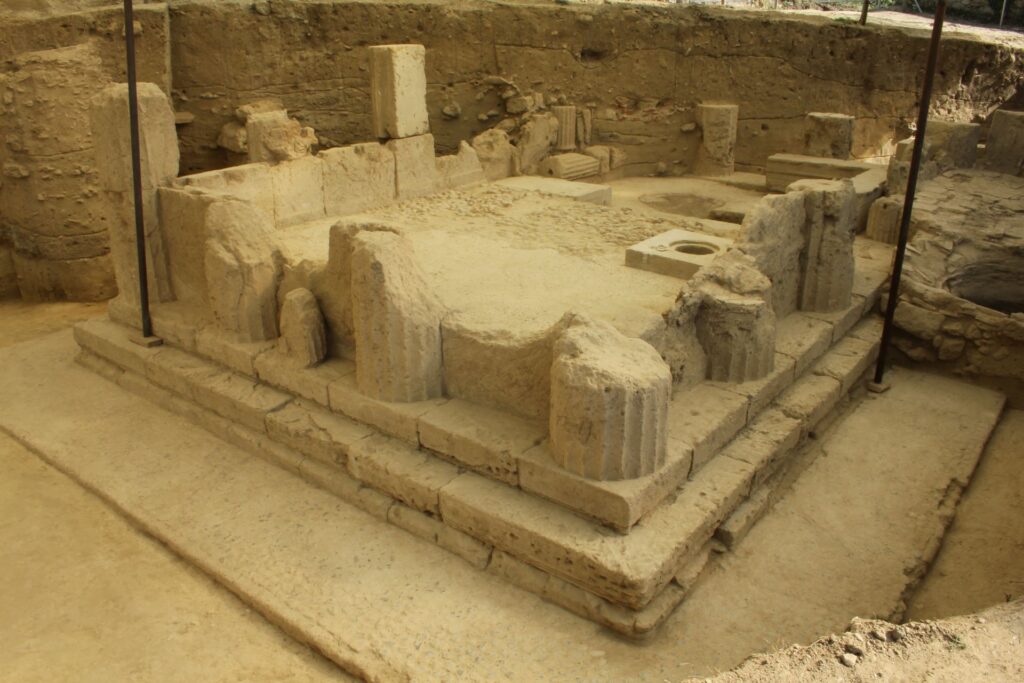
The excavations of archaeologist Xenia Arapogianni at the site of Panagitsa, on the western outskirts of the Hellenic Thouria ridge and at a distance of approximately 10 km northwest of Kalamata, brought to light building remains that, according to epigraphic evidence, belonged to the sanctuary of the healing deities Asclepius and Hygieia.
The temple of the sanctuary is Doric with an entrance ramp, a prodomus and a cella and was surrounded by semi-columns and uprights.
Inside the cella, parts of an offering table were located, as well as a stone cubic base with a circular cavity that would have been sealed with a metal cover and has been interpreted as a “treasury”, i.e. a treasury, where the faithful would have thrown coins. An inscription on the upper surface of the treasury attests to the architect Theodore and dates the building to the late 4th or early 3rd century BC.
Outside the temple, the magnificent altar was found, as well as pedestals for statues and inscribed columns with references to deities, such as Asclepius, Hygeia and Hermes. A short distance away, parts of two buildings were excavated that form an Ionic portico with apartments in the background, with a public character to serve the needs of the sanctuary.
The ash and abundant animal bones found in the open space between the Ionic portico and the temple and around the altar confirm the performance of sacrifices and other rituals. The sanctuary functioned from the late 4th century BC to the 1st century BC.
Later, in the 7th century AD A vat for wine production was constructed near the western side of the now ruined temple.
https://www.efamess.gr/pois/asklipieio-archaias-thourias/?free=1